How Long Should You Rest Between Sets? What the Research Says
How long to rest between sets? Studies suggest 1–2 minutes for most muscle-building work and 2–3+ minutes for heavy strength lifts. Here is why.
The short answer
- For most muscle-building work, rest about 1–2 minutes between sets. A 2024 meta-analysis found a small benefit to resting more than 60 seconds, with no clear extra gain past 90 seconds.
- For heavy strength work, rest longer. A review of 23 studies concluded that trained lifters likely need more than 2 minutes to maximize strength gains.
- If you're new, 60–120 seconds is enough for strength gains. Rest until you can do your next set with good form, then track it.
Rest time is one of the easiest training variables to ignore. Some people scroll their phone for five minutes between sets; others rush through with 30 seconds because it feels harder and therefore better. Research gives a fairly clear middle ground, and it depends mostly on what kind of set you just did.
The short answer: it depends on your goal
The American College of Sports Medicine's position stand on resistance training gives different rest ranges for different goals (ACSM, 2009). For muscle growth, it recommends loads mostly in the 6–12 rep-max zone with 1–2 minute rest periods. For heavy strength work in intermediate and advanced lifters, it suggests 3–5 minute rests, and for muscular endurance, short rests of under 90 seconds.
| Goal | Typical rest between sets | Based on |
|---|---|---|
| Muscle growth (6–12 reps) | 1–2 min | ACSM (2009); Singer et al. (2024) |
| Heavy strength work (trained lifters) | More than 2 min, often 3–5 min | Grgic et al. (2018); ACSM (2009) |
| Strength as a beginner | 60–120 s | Grgic et al. (2018) |
| Muscular endurance (lighter, higher reps) | Under 90 s | ACSM (2009) |
Newer studies have refined those numbers, and they mostly point in the same direction: resting a bit longer than many gym-goers do tends to help, up to a point.
Rest between sets for muscle growth
The most cited trial on this question had 21 resistance-trained young men follow the same program for 8 weeks: three full-body workouts a week, 3 sets of 8–12 reps on 7 exercises (Schoenfeld et al., 2016). One group rested 1 minute between sets; the other rested 3 minutes. The 3-minute group gained significantly more strength on both the squat and the bench press, and significantly more muscle thickness in the front of the thigh, with a trend toward more in the triceps.
Why would more rest build more muscle? The likely reason is volume. With very short rests you can't recover enough to repeat your reps, so your later sets get lighter or shorter, and you do less total work.
A 2024 systematic review with meta-analysis pooled 9 studies comparing rest periods for muscle growth (Singer et al., 2024). The results overlapped a lot, but they suggested a small benefit to resting more than 60 seconds, and the analysis did not detect meaningful differences once rest went beyond 90 seconds. The authors noted this fits with evidence that the drop in training volume from short rests tends to level off past that point.
Rest between sets for strength
For maximal strength, longer rests matter more. A systematic review of 23 studies with 491 participants found that strength improved even with short rests of under 60 seconds, but concluded that rests of more than 2 minutes seem to be needed to maximize strength gains in people who already lift (Grgic et al., 2018).
That matches how heavy sets feel. A hard set of 3–5 reps on a squat or deadlift taxes your whole body, and coming back too soon usually means fewer reps, worse form, or both. If your next set would otherwise drop off sharply, take the extra minute.
Rest periods for beginners
If you're new to lifting, you have more flexibility. The same review found that in untrained people, short to moderate rests of 60–120 seconds were enough to maximize strength gains (Grgic et al., 2018). Beginners also tend to lift lighter loads relative to what they'll eventually handle, so they recover between sets faster.
A good beginner approach is to rest about 90 seconds on most exercises, and 2–3 minutes on your heaviest lift of the day. What matters more at this stage is turning up consistently and adding a little weight or a rep over time, as explained in our progressive overload guide.
How to time rest without overthinking it
A simple rest routine
- 1
Pick a default by exercise
Big compound lifts: 2–3 minutes. Smaller isolation exercises (curls, raises, extensions): 60–90 seconds.
- 2
Use a timer
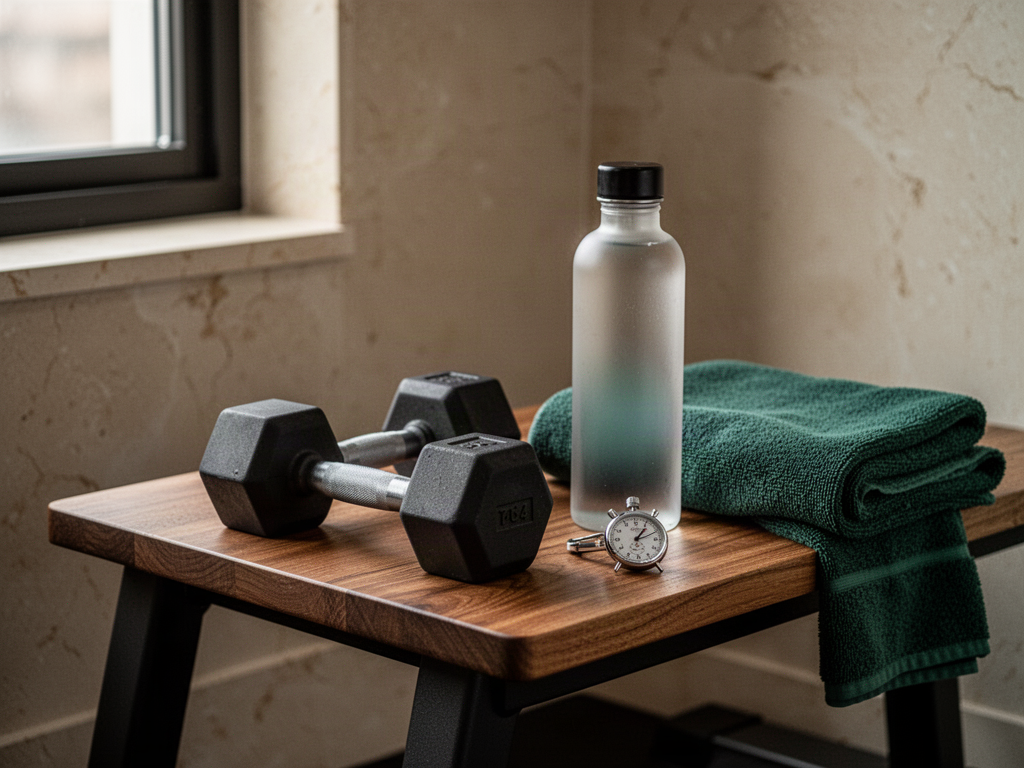
Rest tends to stretch when you're distracted. A simple timer keeps sessions consistent from week to week.
- 3
Check readiness
Before the next set, ask: is my breathing back near normal, and can I hit my target reps with good form? If not, take another 30–60 seconds.
- 4
Keep it the same week to week
If rest changes a lot between sessions, your rep numbers aren't really comparable, which makes progress harder to judge.
Short on time? Rather than cutting rest to 30 seconds, try pairing exercises that use different muscles, such as a press and a row, and alternate between them. Each muscle group still gets a full rest while you keep moving. Recovery outside the gym matters too: eating enough protein supports the muscle you're building (how much protein you need), and if you take creatine, our creatine dosing guide covers what the evidence supports.
Frequently asked questions
Is 60 seconds rest between sets enough?
It can work, especially for beginners and smaller exercises, but for muscle growth a 2024 meta-analysis found a small benefit to resting longer than 60 seconds. For heavy compound lifts, 2–3 minutes or more usually lets you keep your reps up.
Is resting 3 minutes between sets too long?
No. In an 8-week trial, trained men who rested 3 minutes gained more strength and thigh muscle than those who rested 1 minute. It mostly costs time, so save the longest rests for your hardest, heaviest sets.
How long should beginners rest between sets?
About 60–120 seconds is enough for most exercises. A 2018 review of 23 studies found short to moderate rests of 60–120 seconds were sufficient to maximize strength gains in untrained people.
Does shorter rest burn more fat?
Shorter rest makes a session feel harder, but fat loss depends mainly on your overall calorie balance over time. Resting enough to keep your lifts strong helps you hold on to muscle while you lose fat gradually.
Sources
- American College of Sports Medicine (2009). Position stand: Progression models in resistance training for healthy adults. Med Sci Sports Exerc 41(3):687–708
- Schoenfeld B.J. et al. (2016). Longer interset rest periods enhance muscle strength and hypertrophy in resistance-trained men. J Strength Cond Res 30(7):1805–1812
- Grgic J. et al. (2018). Effects of rest interval duration in resistance training on measures of muscular strength: a systematic review. Sports Med 48(1):137–151
- Singer A. et al. (2024). Give it a rest: a systematic review with Bayesian meta-analysis on the effect of inter-set rest interval duration on muscle hypertrophy. Front Sports Act Living 6:1429789
This article is general information, not medical advice. If you have a health condition, are pregnant, or take medication, talk to your doctor or a registered dietitian before changing how you eat or train.